
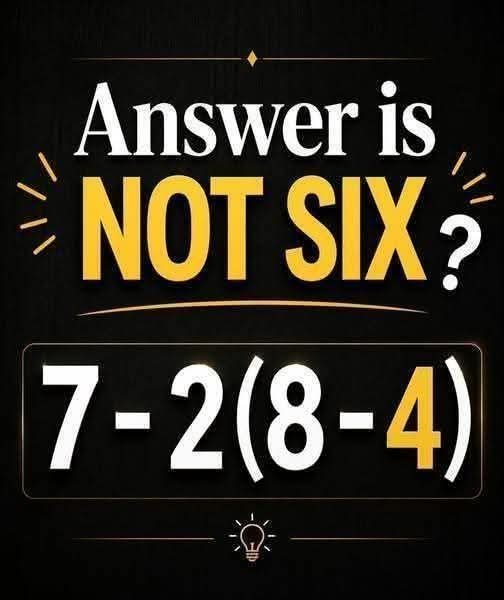
The Viral Math Trap That’s Breaking the Internet: Is the Answer Really NOT 6?
Every few months, a simple-looking arithmetic problem sweeps across social media platforms and sparks thousands of heated debates. Comment sections fill with confident claims, screenshots of calculator apps, and accusations that someone is “doing it wrong.” The latest version of this phenomenon has people asking whether the answer is really not 6, and many readers are scrolling down to find out. This article breaks down why these math puzzles go viral, explains the correct reasoning behind the problem, and gives you practical tools for solving similar brain teasers with confidence.
Why Math Puzzles Go Viral So Quickly
Math brain teasers spread fast for a simple reason: they are designed to provoke a reaction. A problem that looks easy at first glance invites people to answer instantly, and the gap between the answer they expect and the answer they get creates a powerful urge to argue. This emotional friction drives comments, shares, and reactions, which signal to platform algorithms that the content is engaging. The result is a feedback loop where the most confusing problems receive the most visibility.
Many viral puzzles also rely on ambiguity in notation. Symbols such as the division sign, the order in which operations are performed, or the use of implied multiplication can lead two careful readers to different conclusions. When people encounter these ambiguities, they rarely pause to ask what the problem’s author intended. Instead, they defend their first interpretation, and the debate becomes a test of who sounds more certain.
The Role of Order of Operations
Most viral arithmetic traps hinge on the order of operations, often remembered through acronyms such as PEMDAS or BODMAS. The standard rule is that parentheses and exponents are evaluated first, followed by multiplication and division from left to right, and finally addition and subtraction from left to right. Many people learned these rules years ago and remember only fragments of them, which is why a problem that seems simple can produce surprisingly different answers.
The key lesson is that multiplication and division share the same priority and are resolved from left to right, not multiplication first. The same applies to addition and subtraction. Readers who skip this detail often reach the wrong answer while feeling completely sure of themselves. Understanding this single rule resolves a large share of the disagreements you will see online.
How to Solve a Viral Math Problem Step by Step
When you encounter a puzzle that claims a surprising answer, a structured approach will help you reach the correct result without relying on gut instinct. Start by rewriting the expression exactly as shown, without simplifying it in your head. Mark every operation and every set of parentheses so you can see the structure clearly. Next, identify the operations that take priority according to the order of operations, and work through them one at a time, writing each intermediate result down.
It also helps to check your work by estimating. If the numbers are roughly one hundred and the answer is ten, a quick mental estimate will reveal whether a major mistake occurred. Finally, consider whether the problem contains an ambiguous symbol. If it does, the most reasonable interpretation is usually the one the author most likely intended, and it is fair to acknowledge that a different reading exists. This disciplined process turns a confusing internet argument into a clear, verifiable calculation.
Common Mistakes That Lead to Wrong Answers
Several errors appear again and again in comment threads about viral math problems. The most common is performing addition before multiplication, which happens when readers assume the operation that appears first in the sentence takes priority. Another frequent mistake is misreading exponents, particularly when a negative sign or a fraction sits in front of a power. Some people also forget that a term outside parentheses can change the result when the parentheses are expanded, and others accidentally drop a digit while copying the problem.
Calculator use introduces its own pitfalls. Different calculator brands handle implied multiplication and operator precedence differently, which is why two people using different devices can report opposite answers. When you compare results, always confirm the exact input you typed and check whether your calculator follows standard order of operations. Writing the problem on paper and working through it manually remains one of the most reliable ways to avoid these errors.
Why Confident Comments Are Not Proof
A large number of comments on viral math posts claim a definitive answer, often in capital letters and with a tone of certainty. Confidence, however, is not evidence. Some commenters are simply repeating a memory of a rule they once learned, while others are reacting to the first answer they saw. Pay attention to whether a commenter shows their steps. A clear, sequential explanation is far more trustworthy than a bare assertion or a claim that the answer is hidden somewhere else.
Be especially wary of posts that promise the answer “in the comments” or ask you to follow a link to reveal it. These tactics are designed to maximize engagement rather than to teach you anything. The best way to learn the correct answer is to work through the problem yourself using the steps outlined above, then compare your reasoning with a well-explained solution.
Building Stronger Math Skills for Everyday Life
Beyond settling internet arguments, strong number sense has practical value. It helps with budgeting, comparing prices, understanding loan interest, and evaluating statistics in the news. Many people feel anxious around math because they were taught rules without reasons. Taking time to understand why the order of operations exists, and how each operation relates to the others, builds genuine confidence that lasts well beyond a single puzzle.
If you want to improve, consider practicing with short daily problems, using a notebook to show every step, and reviewing mistakes rather than simply marking them wrong. Online courses, printable worksheets, and reputable math tutoring platforms can also provide structured practice. Over time, you will find that viral puzzles become less intimidating and more like a fun exercise in careful reading.
Conclusion
The viral math trap that has the internet arguing is a perfect example of how a simple expression can produce a surprising amount of confusion. The most reliable path to the correct answer is to rewrite the problem carefully, apply the order of operations from left to right within each priority level,